
Industrial refrigeration has always been shaped by a balance between efficiency, reliability, and operating economics. In that balance, ammonia-based refrigeration systems continue to hold a significant position across food processing plants, cold storage facilities, dairy operations, breweries, ice plants, and chemical manufacturing environments.
What is interesting is that despite rapid advances in refrigeration technology, ammonia compressors remain deeply relevant because they solve a very practical industrial problem: moving large refrigeration loads efficiently over long operating cycles.
In many manufacturing facilities, refrigeration is not merely a utility system. It directly affects production continuity, material stability, and product quality. That is why engineering teams often evaluate compressors less on marketing claims and more on operating behavior under sustained industrial conditions.
Among the different technologies used in industrial refrigeration, ammonia reciprocating compressors are widely recognized for their controllability, durability, and suitability for medium-to-large refrigeration capacities.
Understanding the Industrial Context of Ammonia Compressors
Industrial refrigeration systems are fundamentally different from commercial air-conditioning systems.
A factory handling dairy products, frozen foods, pharmaceuticals, or process cooling typically operates under:
- Continuous thermal loads
- High ambient temperature variations
- Long operational cycles
- Strict process temperature requirements
- Energy efficiency constraints
In such environments, ammonia refrigerant systems are often selected because ammonia offers:
- High thermodynamic efficiency
- Excellent heat transfer characteristics
- Lower refrigerant charge requirements in some designs
- Strong performance in large-capacity refrigeration systems
This is also why manufacturing clusters across India continue to use ammonia refrigeration in centralized cooling systems.
Companies operating from industrial regions like New Delhi frequently supply these systems to facilities across multiple states through structured engineering and distribution networks. Maharani Industrial Euqipments, for instance, supports refrigeration infrastructure requirements across different industrial sectors through Pan-India supply capabilities.
For regional industrial infrastructure references and operational coverage, their presence across locations can be reviewed Maharani Industrial Equipments Private Limited
What Is an Ammonia Compressor?
An ammonia compressor is a mechanical device used in industrial refrigeration systems to compress ammonia refrigerant gas, increasing its pressure and temperature so it can circulate through the refrigeration cycle efficiently. These compressors are commonly used in cold storage, food processing, chemical plants, and large-scale industrial cooling applications.
Ammonia compressors operate as the central driving component of refrigeration systems. Without compression, the refrigerant cannot effectively absorb and reject heat through the evaporator and condenser cycle.
How Does an Ammonia Compressor Work?
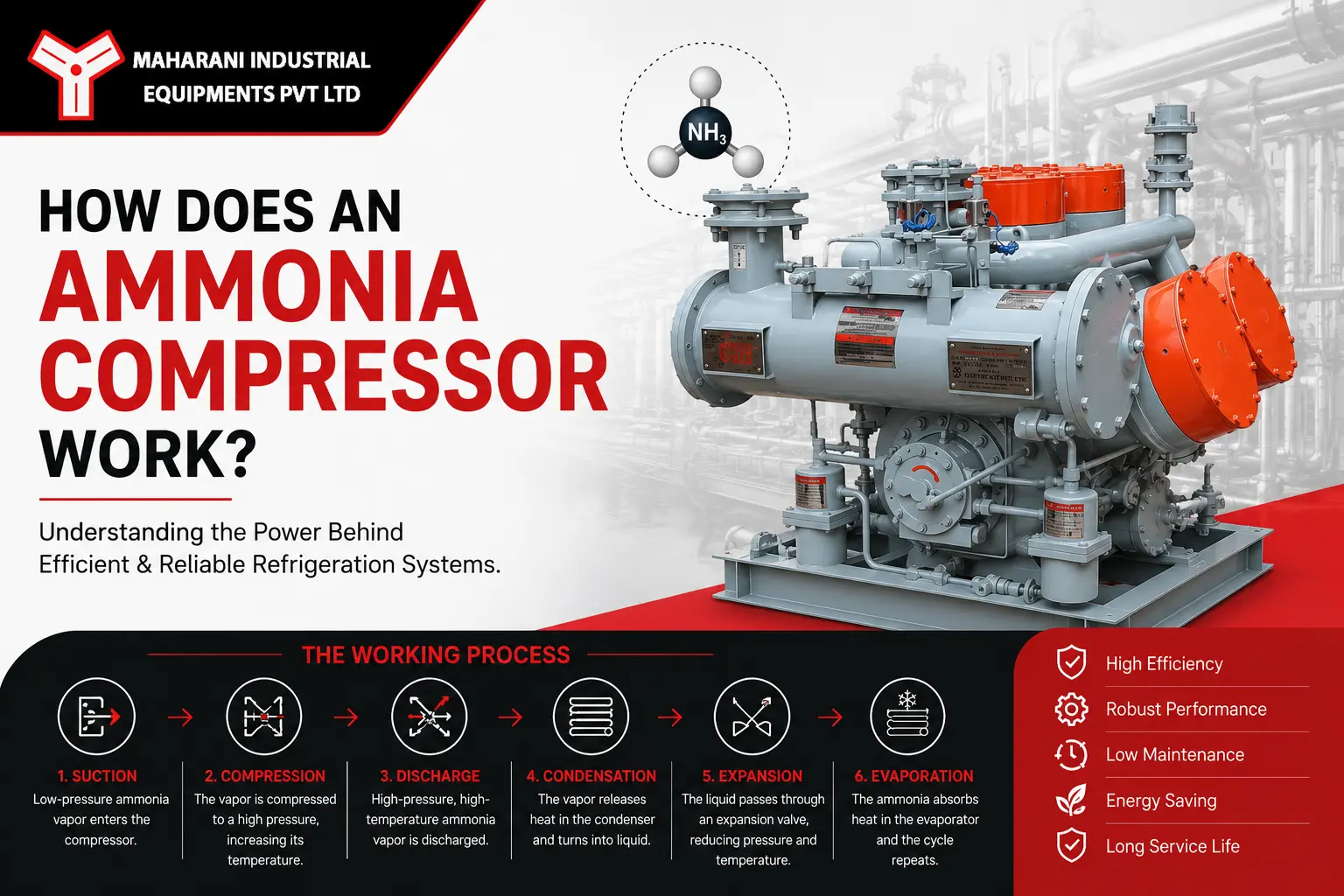
An ammonia compressor works by drawing low-pressure ammonia vapor from the evaporator, compressing it into high-pressure gas, and sending it to the condenser where heat is released. The refrigerant then cools, expands, and returns to absorb heat again, completing the refrigeration cycle.
Although the process sounds straightforward, actual industrial operation involves several coordinated stages.
Step-by-Step Working Principle
1. Suction Phase
Low-pressure ammonia vapor enters the compressor cylinder through the suction valve.
This vapor typically carries absorbed heat from:
- Cold storage chambers
- Process cooling lines
- Refrigerated manufacturing systems
At this stage, refrigerant pressure and temperature remain relatively low.
2. Compression Stage
Inside reciprocating compressors, pistons move within cylinders to compress ammonia vapor.
As pressure rises:
- Vapor temperature increases
- Gas density changes
- System energy transfer becomes possible
The compression ratio plays a major role in system efficiency and operating stability.
3. Discharge Process
The compressed high-pressure vapor exits through discharge valves and moves toward the condenser.
Here, heat rejection occurs through:
- Air-cooled condensers
- Evaporative condensers
- Water-cooled systems
4. Expansion and Recirculation
After condensation:
- Liquid ammonia passes through an expansion device
- Pressure reduces rapidly
- Refrigerant enters the evaporator again
- Heat absorption restarts
This cycle repeats continuously during industrial operation.
One practical observation often overlooked in procurement discussions is that compressor efficiency is not determined by compression alone. System piping layout, oil management, load variation, and condenser performance all influence long-term refrigeration stability.
Technical Specifications & Key Features
Ammonia reciprocating compressors are generally engineered for industrial-duty performance rather than intermittent commercial use.
Typical specification considerations include:
Parameter |
Common Industrial Range |
|
Refrigerant Type |
Ammonia (NH3) |
|
Compression Method |
Reciprocating |
|
Cooling Capacity |
Small to large industrial loads |
|
Operating Pressure |
Application-dependent |
|
Cylinder Configuration |
Single-stage / Multi-stage |
|
Lubrication System |
Forced lubrication |
|
Drive Type |
Direct drive / Belt drive |
|
Capacity Control |
Step or variable unloading |
Key Functional Features
High Compression Efficiency
Reciprocating compressors maintain stable compression under variable industrial loads.
Capacity Control
Many industrial systems use unloading mechanisms to match refrigeration demand fluctuations.
Serviceability
Industrial buyers frequently prefer reciprocating designs because components like:
- Pistons
- Valves
- Bearings
- Gaskets
can often be serviced without replacing the entire machine.
Adaptability to Process Environments
These systems are commonly integrated into:
- PLC-based automation systems
- Industrial monitoring controls
- Temperature management frameworks
Materials & Production Methodology
Material selection significantly influences compressor reliability.
In industrial refrigeration, exposure to pressure cycling, vibration, thermal variation, and lubricant interaction requires careful engineering consideration.
Common Materials Used
Component |
Common Material |
|
Compressor Body |
Cast iron / high-grade steel |
|
Pistons |
Alloy steel |
|
Valves |
Hardened steel |
|
Shafts |
Forged steel |
|
Gaskets & Seals |
Industrial-grade elastomers |
Production Considerations
A well-manufactured ammonia compressor generally involves:
- Precision machining of cylinders
- Tight dimensional tolerances
- Surface finishing for reduced friction
- Dynamic balancing of moving parts
- Pressure integrity testing
In industrial environments, small manufacturing deviations can eventually lead to:
- Refrigerant leakage
- Efficiency losses
- Vibration-related failures
- Premature wear
This is why experienced procurement teams often evaluate manufacturing consistency rather than focusing only on initial pricing.
Performance & Durability Insights
Ammonia refrigeration systems often operate continuously for extended periods.
Under such conditions, compressor durability becomes closely linked to:
- Lubrication stability
- Heat dissipation
- Valve integrity
- Pressure balance
- Operating load consistency
Factors Affecting Long-Term Performance
Operating Temperature
High discharge temperatures can reduce oil effectiveness and increase internal wear.
Refrigerant Purity
Contaminated ammonia may damage valves and internal surfaces.
Oil Management
Improper lubrication remains one of the most common causes of compressor inefficiency.
Load Cycling
Frequent start-stop operation can increase mechanical stress.
One pattern observed across industrial facilities is that compressors failing prematurely are not always poorly designed. In many cases, mismatched system sizing or neglected maintenance routines create avoidable operational strain.
Applications & Industrial Use Environments
Ammonia compressors are primarily used where large-scale refrigeration demand exists.
Common Application Areas
- Cold storage warehouses
- Food processing plants
- Ice manufacturing units
- Dairy processing facilities
- Breweries
- Seafood processing
- Pharmaceutical production
- Chemical process cooling
Industrial Operating Conditions
These systems may function in environments involving:
- High humidity
- Dust exposure
- Continuous operation
- Variable thermal loads
- Multi-zone refrigeration networks
Industrial refrigeration design therefore focuses heavily on operational stability rather than only peak cooling performance.
Reciprocating vs Screw Ammonia Compressors
Industrial buyers frequently compare reciprocating compressors with screw compressor systems.
Both have advantages depending on operational priorities.
Factor |
Reciprocating Compressor |
Screw Compressor |
|
|
|
Load Flexibility |
Strong at variable loads |
Better for continuous high loads |
||
|
Maintenance |
Component-level servicing possible |
More specialized servicing |
||
|
Initial Investment |
Often lower |
Typically higher |
||
|
Efficiency Range |
Effective across varying capacities |
Strong in large continuous systems |
||
|
Noise & Vibration |
Higher mechanical movement |
Smoother operation |
||
|
Capacity Scale |
Medium to large |
Large industrial scale |
||
There is no universally “better” option.
System selection usually depends on:
- Cooling load profile
- Operating hours
- Maintenance capability
- Energy strategy
- Facility size
Buyer Evaluation Checklist
Before selecting an ammonia compressor, engineering and procurement teams often evaluate the following:
Technical Evaluation Points
- Required refrigeration capacity
- Operating pressure range
- Ambient operating conditions
- Power consumption expectations
- Compressor staging requirements
- Automation compatibility
- Maintenance accessibility
Reliability Indicators
- Manufacturing precision
- Service network availability
- Spare part accessibility
- Material quality consistency
- Pressure testing standards
Operational Questions
- Will the compressor operate continuously?
- Are load fluctuations frequent?
- Is future capacity expansion expected?
- Does the facility have trained maintenance personnel?
Thoughtful evaluation at this stage often reduces long-term operational complications significantly.
Frequently Asked Questions
1. What is ammonia used for in compressors?
Ammonia is used as a refrigerant in industrial cooling systems because of its high heat absorption efficiency and suitability for large-scale refrigeration applications.
2. Why are reciprocating ammonia compressors widely used?
Reciprocating ammonia compressors are widely used because they offer controllable capacity, reliable compression performance, and easier component-level maintenance in industrial refrigeration systems.
3. Are ammonia compressors suitable for continuous operation?
Yes. Industrial ammonia compressors are commonly designed for long-duration and continuous operating cycles when maintained under proper operating conditions.
4. What industries commonly use ammonia refrigeration systems?
Industries such as food processing, cold storage, dairy, pharmaceuticals, breweries, and chemical manufacturing frequently use ammonia refrigeration systems.
5. How important is maintenance in ammonia compressor performance?
Maintenance is critical. Lubrication quality, valve inspection, refrigerant purity, and operating temperature control strongly affect compressor efficiency and durability.
Supply & Distribution Capability
Industrial refrigeration procurement often depends not only on equipment quality but also on technical coordination, installation planning, and service accessibility.
Manufacturers operating from industrial centers like New Delhi often support projects across multiple regions due to centralized engineering and logistics capabilities.
Maharani Industrial Euqipments supplies ammonia reciprocating compressor systems for industrial refrigeration applications across India. Their product range and technical details can be reviewed here:
Ammonia Reciprocating Compressor Solutions
In large industrial projects, supplier evaluation increasingly includes:
- Engineering responsiveness
- Documentation quality
- Operational guidance
- Long-term maintainability
rather than focusing only on equipment procurement cost.
Conclusion
Ammonia compressors continue to play a central role in industrial refrigeration because they align well with the realities of large-scale cooling operations: continuous duty cycles, energy efficiency requirements, and process reliability expectations.
Reciprocating compressor systems, in particular, remain relevant because they provide a balance between controllability, serviceability, and operational performance across varied industrial conditions.
At the same time, compressor selection should rarely be treated as an isolated equipment decision. Refrigeration load behavior, plant environment, maintenance capability, and long-term operating strategy all influence whether a system performs efficiently over time.
If you are evaluating ammonia compressors for an upcoming industrial project, reviewing operating conditions, load requirements, and technical specifications carefully can help reduce procurement and operational risks. For additional technical guidance or product-related information, you can connect with Maharani Industrial Euqipments through their contact page: